

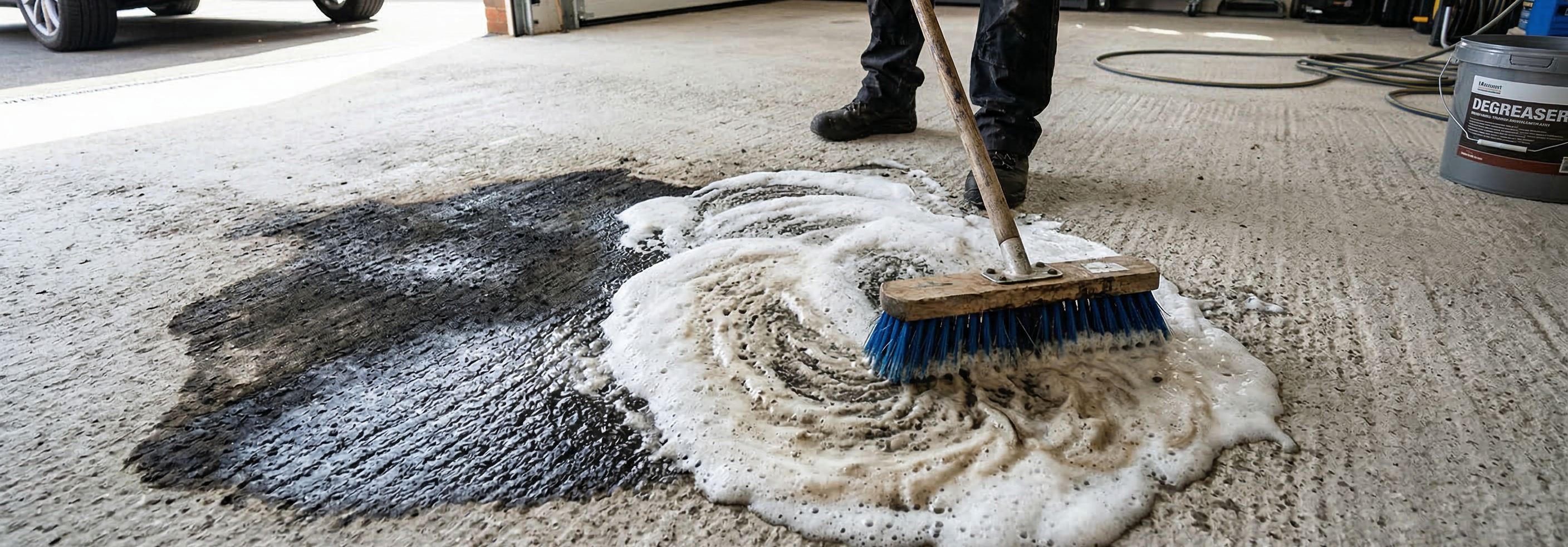
If you are planning to paint your garage floor or seal your driveway, that dark patch where your old car used to leak is your biggest problem. If you paint directly over an oil stain - even a dry, old one - the paint will delaminate. The oil rises up through the pores, breaks the chemical bond, and your new floor will peel up in a perfect circle.
Many homeowners try to attack these stains with dish soap or a pressure washer, only to find the stain returns as soon as the concrete dries. This is because removing oil stains from concrete requires drawing the contaminant out of the heavy pores, not just washing the surface.
Here is the professional method for degreasing concrete effectively.
Step 1: Assess the Damage (Fresh vs. Old)
How you tackle the oil depends on how long it has been there.
-
Fresh Spills (Wet Oil): Do not wet the floor yet. If the oil is still wet, cover it immediately with absorbent granules, cat litter, or sawdust. Grind it in with your boot and leave it for 24 hours to suck up the liquid.
-
Old Stains (Dry/Dark Patches): This oil has soaked deep into the "capillaries" of the concrete. You need a chemical emulsifier to drag it out.
Step 2: Choose the Right Chemical
Standard household cleaners are not strong enough for porous masonry. You need a dedicated Concrete Cleaner for Oil or an industrial Traffic Film Remover.
These products are surfactants that break the surface tension of the oil, allowing water to mix with it (emulsification) so it can be flushed away.
Step 3: The Scrub and Soak Method
Spraying the cleaner on the stain isn't enough. You need mechanical action.
-
Apply Generously: Pour your Industrial Degreaser directly onto the stain. Do not dilute it for heavy stains.
-
Agitate: This is the most critical step. Use a stiff deck brush to scrub the chemical vigorously into the stain for 2-3 minutes. You want to force the degreaser deep into the pores.
-
The Dwell Time: Walk away. Let the chemical sit for 15-20 minutes. It needs time to break down the hydrocarbon chains.
-
Important: Do not let it dry. If it starts to dry out, mist it with a little water.
Step 4: The Rinse (and Repeat)
Flush the area with hot water (if possible) or a pressure washer.
-
The "Shadow" Warning: After rinsing, the concrete might look clean while it's wet. But as it dries, you might see the "shadow" of the stain return. This means there is still deep-seated oil rising to the surface. You must repeat the process until the shadow is gone.
The Final Check: The Water Bead Test
You cannot rely on your eyes alone. You must test the surface physics.
Once the floor is dry, drop a teaspoon of water onto the spot where the stain was.
-
Fail: If the water beads up (sits like a bubble), there is still oil residue. You must degrease again.
-
Pass: If the water soaks into the concrete immediately and turns it dark, the pores are open and ready for paint.
Conclusion
Painting over oil stains is a gamble you will always lose. It is better to spend an extra day scrubbing than to spend a weekend scraping up failed paint.
Share:
Pressure Washing Dos and Don'ts: Avoiding Damage to Your Patio
Industrial Floor Cleaning: Manual Mopping vs. Machine Scrubbers